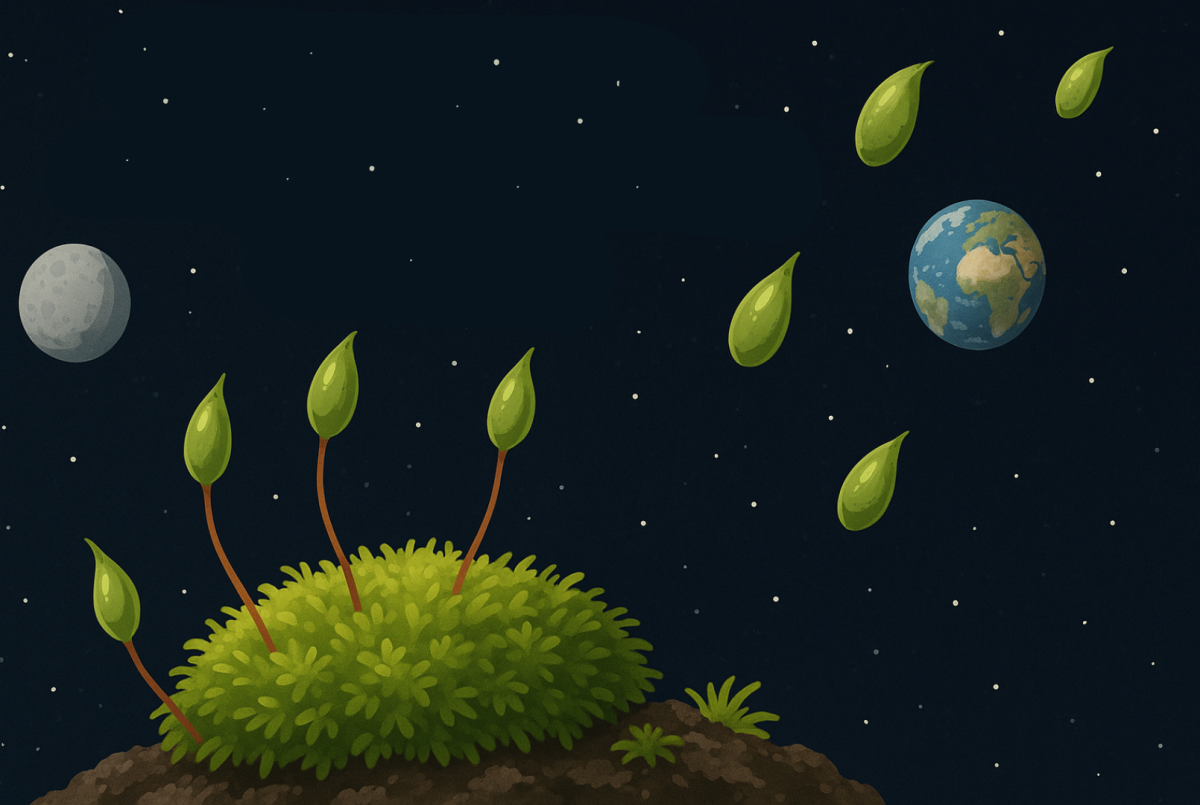
Space: a vast expanse of matter and energy, entirely uninhabitable to life as we know it. There’s no oxygen or essential resources to support organisms, so how were moss spores able to grow in space?
On the International Space Station, moss spores were able to survive for nine months in open space. Not only did they survive, but around 86% of them germinated and even started to grow.
This type of moss, scientifically known as Physcomitrium patens, has been added to a surprising list of organisms that are able to survive extended amounts of time in the harsh environment of space. This group includes species of bacteria, lichens and plant seeds.
A team of scientists first tested the spores in a simulated space environment, including extreme temperatures, high levels of ultraviolet radiation and a vacuum. However, even though the spores successfully survived the experiments, the team was still hesitant to believe that the moss would actually survive in space.
` The spores were in a dry and dormant state, which made them resilient to dehydration and extreme temperature swings. In addition, they were encased in a natural barrier called sporangium, protecting them from UV radiation. These precautions made the spores more durable in the vacuum of space.
When astronauts on the ISS received the samples, they attached them to the exterior of the station. The moss stayed put for 283 days, before coming back to Earth on a carbon capsule.
Scientists expected to find a container full of mostly dead spores, but surprisingly, around 80% of the organisms were alive and healthy, and appeared to be able to survive much longer in space than 9 months.
The next step for the P. patens spores is to undergo DNA testing to assess the damage that occurred during their stay in space, and to track how they recover now that they are back on earth.
The implications of this discovery are vast, as scientists can begin to uncover how organisms recover from the harsh conditions of space. In addition, it can help scientists develop new ideas for human travel outside of Earth, as we look to the moon and mars, helping to provide life support like food and oxygen.