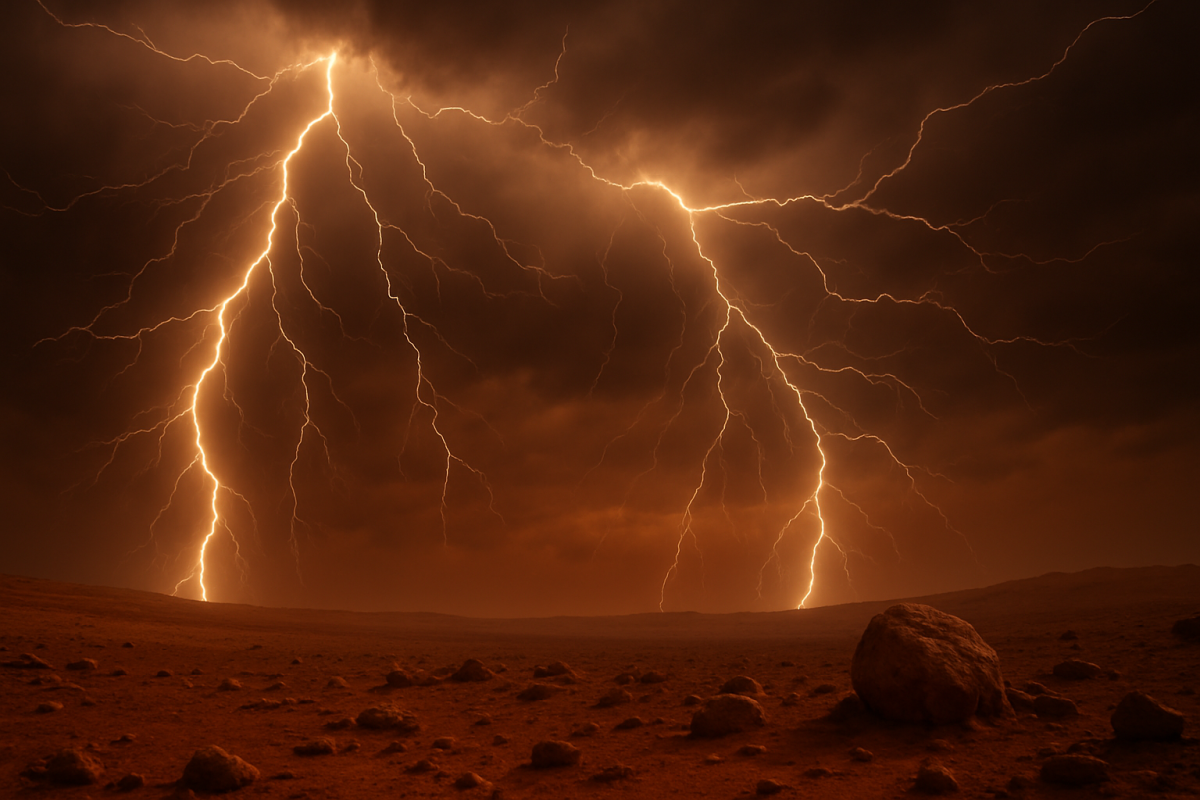
Thunder, commonly associated with rainstorms and lightning strikes, is an environmental phenomena that most people are familiar with. Thunder on Earth is mostly produced by lightning strikes heating up air to such a speed that it creates an incredibly loud boom, but Earth isn’t the only planet that withholds thunder in the Milky Way Galaxy.
Recently, scientists at NASA have discovered that actions on Mars have led to the development of thunder within its atmosphere. The Perseverance rover, which has been on Mars for four years, was the rover that captured the sound of the thunder. The sound was described as a quick crackle and has been noted to capture 55 instances of thunder.
Thunder on Mars does not occur because of lightning strikes the same way it does on Earth. Due to the lack of rain on Mars lightning strikes do not naturally occur, rather small bursts of lightning happen because of rapid movements in dust storms and dust devils. Although much smaller in impact and quieter in sound, the thunder is still produced by shifts in energy on Mars.
Scientists have been trying to understand weather patterns and natural occurrences on Mars for around half of a decade. Within this time numerous rovers and other devices have been sent to the planet to understand the atmosphere. However, none of these excursions led to concrete evidence that thunder is on Mars until now.
The discovery of the origins of the thunder has explained many questions that researchers have had on the atmosphere of Mars. Previously there was an abundance of elemental compounds that were seemingly unexplainable, but the existence of lighting confirms that the compounds were created by the interactions of electricity.
Understanding more about Mars and separate planets not only allows scientists to understand nature’s biggest questions, but also can be a catalyst for increased space exploration and maybe even the possibilities of humans inhabiting another planet.