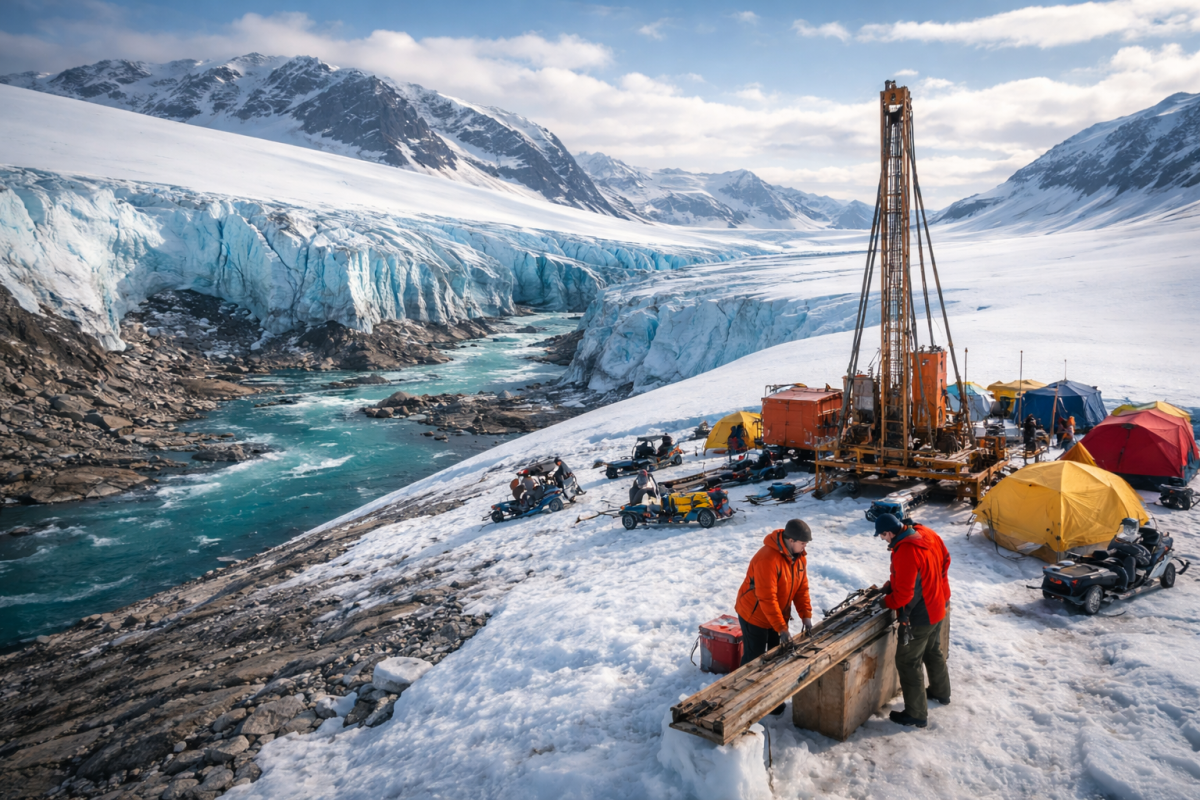
Despite its name, roughly 80% of Greenland is covered by ice-caps and glaciers. One of these massive ice caps is called the Prudhoe Dome located in the northwestern region of the territory. According to data recently discovered, around 7,000 years ago, the entire ice cap melted due to high temperatures. Earth is reaching similar global temperatures, raising concern from scientists around the world that the ice cap may melt once again.
The study, the first of its kind, was conducted by GreenDrill, a co-op funded by the National Science Foundation and led by multiple research universities. Researchers established two different drill sites within the Prudhoe Dome, and drilled 500 metres down through frozen ice sheets to collect a 7-metre sample of sediment and bedrock.
Once the sample was extracted, scientists used a dating technique called luminescence dating and determined that the sample was last exposed to light 6,000 to 8,200 years ago, meaning that the dome was completely melted at the time.
With this evidence, researchers were able to conclude information about the earth’s climate at the time, leading them to believe the ice sheets are very sensitive to temperature changes. 7,000 years ago, global temperatures in the summer were only 3 to 5 degrees warmer than current temperatures. Earth is projected to reach those same temperatures by the year 2100.
These results have large implications for the rise in sea levels as well. If the entire Prudhoe Dome ice sheet were to melt, it could result in sea levels rising up to 1 metre. Scientists plan to analyze vulnerable areas along the edge of the ice cap, to determine where it will melt first, in order to predict which coastal communities will be affected by the inevitable rise in sea levels.
Although they’ve already made discoveries, GreenDrill plans to continue their research as well as to develop the field of ice drilling.